
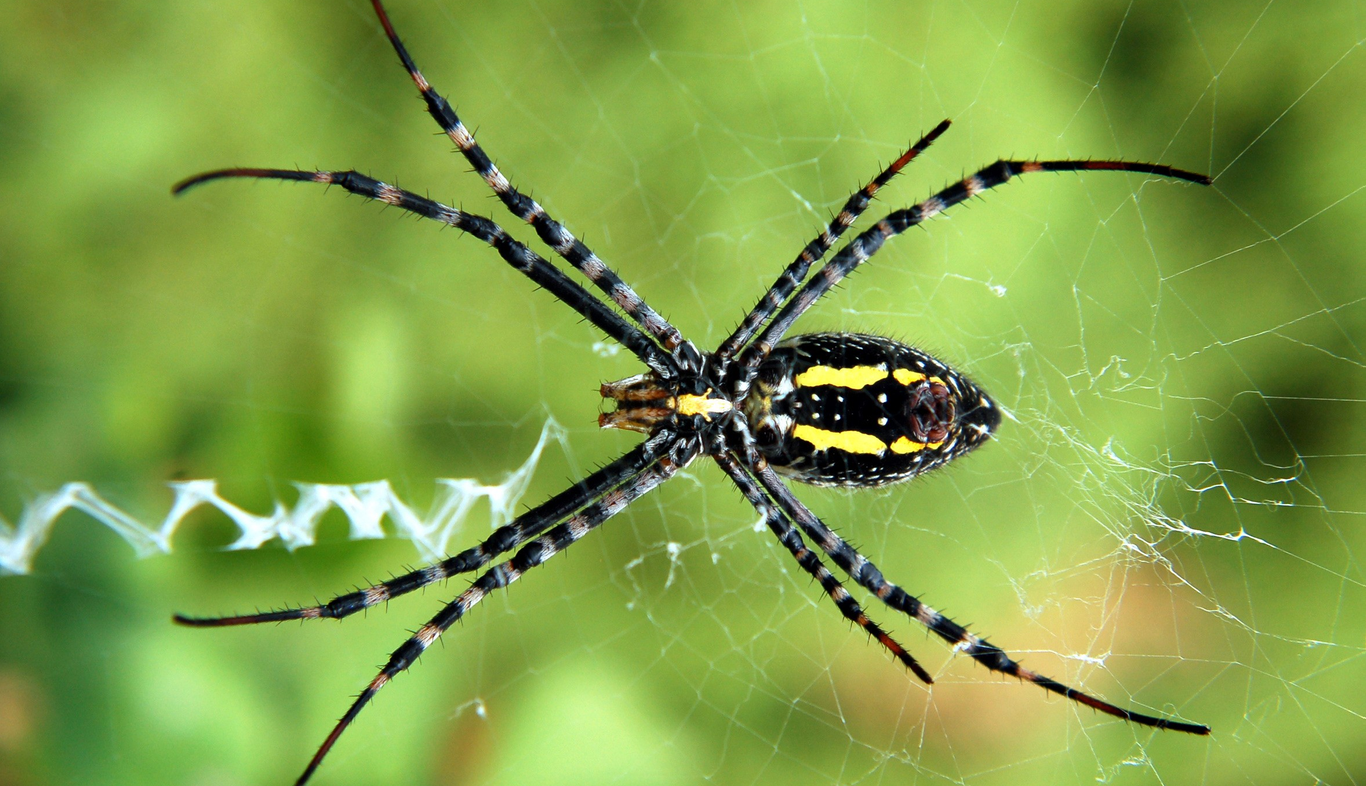
The yellow garden spider (Argiope aurantia), also known as the black-and-yellow garden spider, is a large orb-weaving spider commonly found in gardens, fields, meadows, and other sunny areas with plenty of vegetation. Its striking coloration and large web make it one of the easiest garden spiders to recognize.
Identification
Yellow garden spiders have a distinctive black abdomen marked with bright yellow or orange patches. Their long legs are usually black with yellow, orange, or pale bands.
Females are much larger and more noticeable than males. An adult female can reach about 19–28 mm in body length, excluding the legs, while males are considerably smaller.
One of the clearest signs of this species is its web. The spider often builds a large, circular orb web with a prominent zigzag band of thick white silk running through the center. This structure is called a stabilimentum.
Behavior
Yellow garden spiders are generally calm and non-aggressive toward people. They usually remain near the center of their web, waiting for insects to become trapped.
When prey such as flies, grasshoppers, bees, or moths hits the web, the spider quickly approaches it, bites it, and often wraps it in silk before feeding.
If disturbed, the spider may cause its web to vibrate rapidly. This behavior may help confuse potential predators. It will usually try to escape rather than bite a person.
Females spend much of the summer building and repairing their webs. Toward the end of the season, they produce brown, papery egg sacs containing hundreds of eggs.
Interesting Facts
- They rebuild their webs frequently. Parts of the orb web may be eaten and reconstructed, allowing the spider to recycle silk proteins.
- The zigzag web decoration has several possible functions. Scientists have proposed that it may strengthen the web, attract prey, warn birds away, or help camouflage the spider.
- Females are dramatically larger than males. The difference in size between the sexes is especially noticeable in this species.
- They are useful garden predators. Yellow garden spiders naturally reduce populations of many flying and jumping insects.
- Their appearance is more intimidating than their bite. They are capable of biting if handled or trapped against the skin, but they are not considered dangerous to most people.
- Their webs can be impressive in size. Large females may build orb webs more than half a meter across.
Despite their dramatic appearance, yellow garden spiders are valuable predators and an important part of garden ecosystems. Their elaborate webs and distinctive markings make them one of North America's most recognizable orb-weaving spiders.