
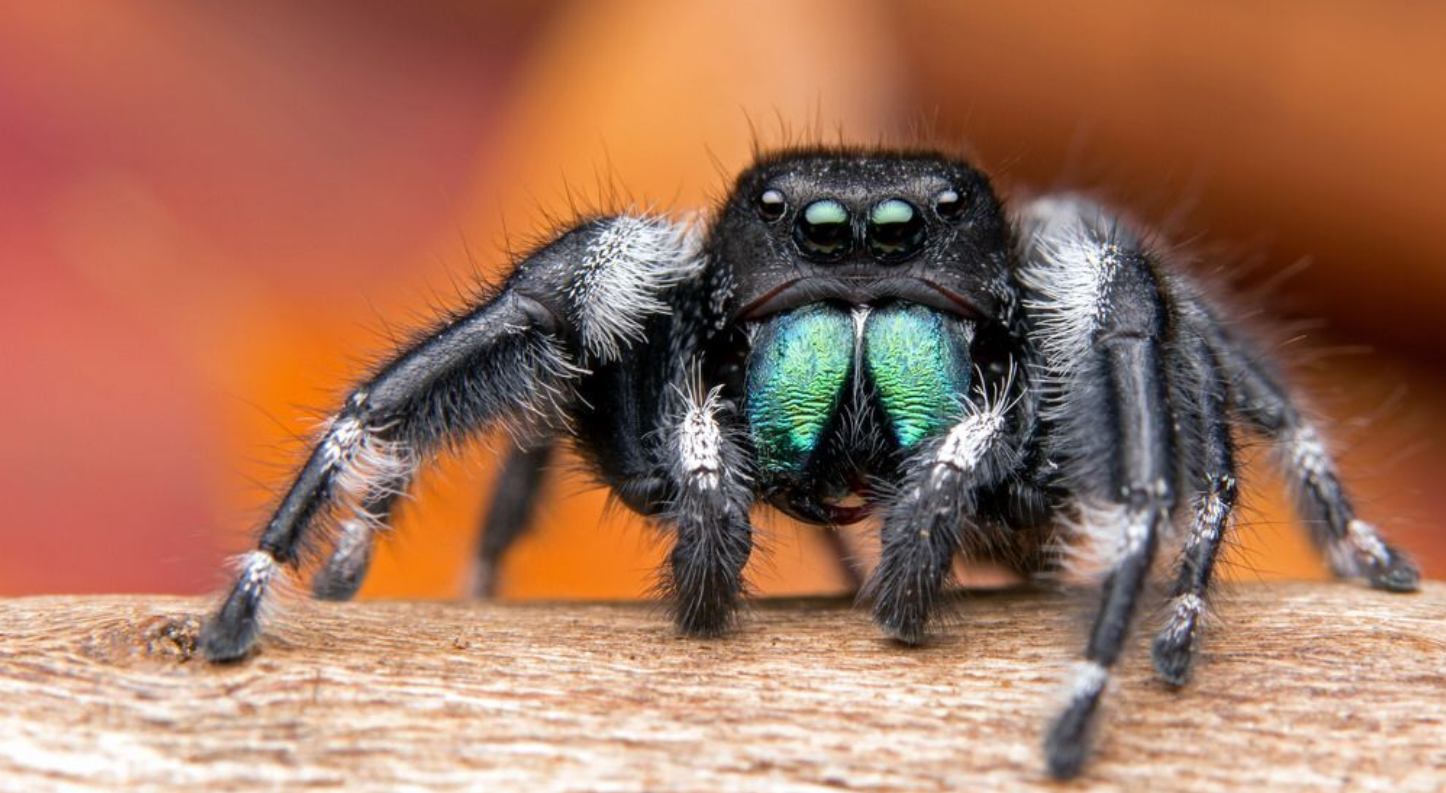
The bold jumping spider (Phidippus audax) is one of the most recognizable jumping spiders in North America. Unlike web-building spiders, it is a cursorial hunter, actively stalking and pouncing on prey rather than using a capture web.
Bold jumping spiders are commonly found in gardens, fields, fences, walls, tree trunks, and around buildings. Their compact bodies, large forward-facing eyes, and deliberate movements make them relatively easy to distinguish from many other spiders.
Identification
Bold jumping spiders are usually black with contrasting white, orange, or reddish markings. Adults often have three prominent spots on the abdomen, with the central spot shaped somewhat like a triangle or irregular patch.
Young individuals may have orange or reddish abdominal markings that become whiter as they mature.
Their most distinctive feature is their large front-facing pair of eyes. Jumping spiders have eight eyes in total, but the enlarged central eyes give them unusually sharp vision.
Adults are relatively small compared with large orb-weavers. Females are generally larger and more robust than males.
The chelicerae, or mouthparts, can have a striking metallic green or blue coloration, especially when viewed from the front.
Behavior
Bold jumping spiders hunt during the day and rely heavily on vision. Instead of waiting for prey to enter a web, they actively explore their surroundings and search for insects and other small arthropods.
When a spider detects prey, it may slowly approach, adjust its position, and then suddenly leap onto the target. Before jumping, it usually attaches a silk safety line to the surface beneath it. This allows the spider to recover if it misses its landing.
Bold jumping spiders can hunt flies, moths, mosquitoes, small beetles, caterpillars, and other spiders.
Their excellent eyesight also plays an important role in communication. Males perform visual courtship displays involving raised legs, body movements, and vibrations when approaching females.
Although they do not build webs for catching prey, they still use silk. They construct small silk retreats where they rest, molt, shelter during bad weather, and protect their eggs.
Interesting Facts
-
They have exceptional eyesight. Jumping spiders possess some of the most sophisticated vision among spiders and can detect movement, shapes, and fine details.
-
They calculate their jumps. Before leaping, a bold jumping spider carefully positions itself and judges the distance to its target.
-
They use silk as a safety line. A strand of silk is usually anchored before a jump, functioning much like a climbing rope.
-
They do not need a capture web. Their primary hunting strategy is based on stalking and ambushing prey at close range.
-
Their mouthparts can appear metallic. The green or blue iridescence of the chelicerae is one of the species' most distinctive features.
-
They are active during daylight. Their visual hunting strategy works best in well-lit conditions.
-
They may appear curious. Jumping spiders often turn toward nearby movement and may seem to watch people or objects around them.
-
They are useful predators. By feeding on many small insects, they can help reduce pest populations in gardens and around buildings.
Despite their compact size, bold jumping spiders are highly capable predators. Their advanced vision, precise movements, and unusual hunting behavior make them an excellent example of how cursorial spiders can succeed without relying on prey-catching webs.